
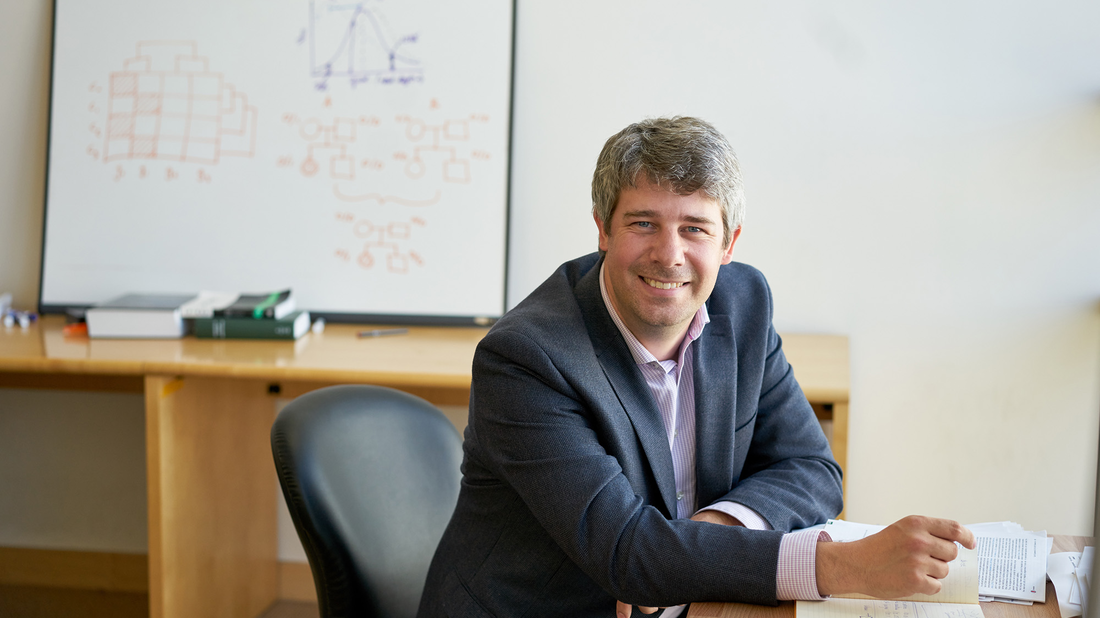
Stephan Sanders, PhD
Working Title
Associate Professor
Dr. Sanders trained as a pediatric physician in the UK before undertaking a PhD and postdoctoral research position at Yale. He is now an Associate Professor at UCSF in the Department of Psychiatry. His research focuses on using genomics and bioinformatics to understand the etiology of developmental disorders, such as Autism Spectrum Disorder (ASD).
As a member of Dr. Matthew State's lab, he worked with the Simons Simplex Collection Genomic Consortium (SSCGC) to quantify the role of de novo copy number variants (CNVs) in ASD, including discovering that de novo duplications at 7q11.23 are an ASD risk factor (Sanders et al. Neuron 2011). He also used exome sequencing to show that de novo protein-truncating variants PTVs (also called loss-of-function (LoF) mutations) are associated with ASD. This analysis established a statistical framework for identifying the specific genes involved in ASD pathology, based on these de novo events, discovering that the voltage-gated sodium channel SCN2A is an ASD risk gene (Sanders et al. Nature 2012).
Combining data from the Simons Simplex Collection (SSC), Autism Sequencing Consortium (ASC), and the Autism Genome Project (AGP), Dr. Sanders’ work identified 65 ASD-associated genes and 6 ASD-associated CNV loci (Sanders et al. Neuron 2015). In addition, by comparing the CNV and exome data, this analysis showed that a single critical gene is often present in small de novo deletions (e.g. <7 genes), whereas large de novo CNVs tend to contain multiple risk genes of lower effect.
As a PI, Dr. Sanders co-leads the whole-genome sequencing (WGS) working group of the ASC with Michael Talkowski). This group developed the Category-Wide Association Study (CWAS) approach to WGS analysis, which provides a framework to define and account for the multiple comparisons inherent to these analyses (Werling et al. Nature Genetics 2018). He is also a member of the Whole-Genome Sequencing in Psychiatric Disorders (WGSPD) steering group, which seeks to integrate WGS data across multiple disorders to maximize power (Sanders et al. Nature Neuroscience 2018).
His lab has helped understand the role of SCN2A mutations in human disorders. In collaboration with Dr. Kevin Bender, he showed that loss-of-function variants that reduce neuronal excitability lead to ASD and developmental delay, while gain-of-function variants that increase neuronal excitability lead to infantile seizures (Ben-Shalom et al. Biological Psychiatry 2017). The loss-of-function mutations also impact back-propagation of the action potential and synaptic plasticity (Spratt et al. BioRxiv 2018), potentially opening an avenue to future therapeutics, as discussed in the review written in collaboration with the SCN2A family group and numerous researchers (Sanders et al. Trends in Neuroscience 2018).
Dr. Sanders is the Director of the Psychiatry Department Bioinformatics Core (PsychCore) at UCSF, a member of the SPARK medical genetics committee, the Autism Science Foundation Scientific Advisory Board, and a Section Editor for the Journal of Neurodevelopmental Disorders.
As a member of Dr. Matthew State's lab, he worked with the Simons Simplex Collection Genomic Consortium (SSCGC) to quantify the role of de novo copy number variants (CNVs) in ASD, including discovering that de novo duplications at 7q11.23 are an ASD risk factor (Sanders et al. Neuron 2011). He also used exome sequencing to show that de novo protein-truncating variants PTVs (also called loss-of-function (LoF) mutations) are associated with ASD. This analysis established a statistical framework for identifying the specific genes involved in ASD pathology, based on these de novo events, discovering that the voltage-gated sodium channel SCN2A is an ASD risk gene (Sanders et al. Nature 2012).
Combining data from the Simons Simplex Collection (SSC), Autism Sequencing Consortium (ASC), and the Autism Genome Project (AGP), Dr. Sanders’ work identified 65 ASD-associated genes and 6 ASD-associated CNV loci (Sanders et al. Neuron 2015). In addition, by comparing the CNV and exome data, this analysis showed that a single critical gene is often present in small de novo deletions (e.g. <7 genes), whereas large de novo CNVs tend to contain multiple risk genes of lower effect.
As a PI, Dr. Sanders co-leads the whole-genome sequencing (WGS) working group of the ASC with Michael Talkowski). This group developed the Category-Wide Association Study (CWAS) approach to WGS analysis, which provides a framework to define and account for the multiple comparisons inherent to these analyses (Werling et al. Nature Genetics 2018). He is also a member of the Whole-Genome Sequencing in Psychiatric Disorders (WGSPD) steering group, which seeks to integrate WGS data across multiple disorders to maximize power (Sanders et al. Nature Neuroscience 2018).
His lab has helped understand the role of SCN2A mutations in human disorders. In collaboration with Dr. Kevin Bender, he showed that loss-of-function variants that reduce neuronal excitability lead to ASD and developmental delay, while gain-of-function variants that increase neuronal excitability lead to infantile seizures (Ben-Shalom et al. Biological Psychiatry 2017). The loss-of-function mutations also impact back-propagation of the action potential and synaptic plasticity (Spratt et al. BioRxiv 2018), potentially opening an avenue to future therapeutics, as discussed in the review written in collaboration with the SCN2A family group and numerous researchers (Sanders et al. Trends in Neuroscience 2018).
Dr. Sanders is the Director of the Psychiatry Department Bioinformatics Core (PsychCore) at UCSF, a member of the SPARK medical genetics committee, the Autism Science Foundation Scientific Advisory Board, and a Section Editor for the Journal of Neurodevelopmental Disorders.
- PhD - supervisor: Matt State, 2014 - Genetics, Yale
- Postdoc - supervisor: Matt State, 2011 - Child Study Center, Yale
- MRCPCH (Board equivalent), 2007 - Paediatrics, Royal College of Paediatrics and Child Health (UK)
- BMBS (MD equivalent), 2003 - Medicine, Nottingham Medical School (UK)
Autistic Disorder
Neurodevelopmental Disorders
Coitus
Autism Spectrum Disorder
Condoms
Lubricants
Exome
Child Development Disorders, Pervasive
Sexual Behavior
DNA Copy Number Variations
Genetic Variation
NAV1.2 Voltage-Gated Sodium Channel
Genetic Predisposition To Disease
Orgasm
Mental Disorders
Miscarriage
Prematurity
High-throughput Sequencing
Genomics
Autism Spectrum Disorder (ASD)
De Novo Variation
Childhood-onset Schizophrenia (COS)
Data Analysis
Sodium Channel
Voltage-gated
Type II
Alpha (SCN2A)
Bioinformatics
Congenital Malformations
- Theodore Reich Young Investigator Award, International Society of Psychiatric Genetics, 2019
- UCSF Weill Neurosciences Innovation Award, UCSF Weill Institute for Neurosciences, 2016
- Annual Top 10 Autism Research Papers, Autism Speaks, 2015
- NARSAD Young Investigator Grant, Brain & Behavior Research Foundation, 2015
- International Student Research Fellowship, Howard Hughes Medical Institute (HHMI), 2013
- Gruber Science Fellowship, Gruber Foundation, 2012
October 29, 2014 - Dozens of Genes Associated with Autism in New Research
May 2, 2016 - Neuron paper listed as top advance by IACC
January 28, 2016 - Autism Speaks names top ten research papers of 2015
January 28, 2016 - UCSF-led autism genomics study named a Top 10 Research Paper of 2015
November 6, 2014 - Rising star: Stephan Sanders, accidental geneticist
December 21, 2018 - Science paper listed as top ten notable papers by Spectrum
September 15, 2015 - LabTV: Why Autism Research is Absolutely Fascinating
December 14, 2018 - Promoter mutations associated with autism
October 30, 2014 - Anarchic Autism Genetics Gain a Touch of Clarity
September 28, 2015 - New autism genes are revealed in largest-ever study
July 27, 2021 - May 31, 2027 - Assessing Genomic, Regulatory and Transcriptional Variation at Single Nuclei Resolution in the Brains of Individuals with Autism Spectrum Disorder , Principal Investigator . Sponsor: NIH, Sponsor Award ID: R01MH125516
February 10, 2021 - November 30, 2025 - 2/2 - Identification and Validation of Expression Quantitative Trait Loci (eQTLs) in discrete cell types across human brain development , Principal Investigator . Sponsor: NIH, Sponsor Award ID: U01MH122681
April 5, 2017 - January 31, 2022 - 4/4 - The Autism Sequencing Consortium: Autism Gene Discovery in >50,000 Exomes , Co-Investigator . Sponsor: NIH, Sponsor Award ID: U01MH111662
July 21, 2016 - April 30, 2020 - 3/3 Integrative Genomic Analysis of Human Brain Development and Autism , Co-Investigator . Sponsor: NIH, Sponsor Award ID: R01MH110928
August 1, 2016 - June 30, 2019 - 1/3 Multidimensional investigation of the etiology of autism spectrum disorder , Co-Investigator . Sponsor: NIH, Sponsor Award ID: R01MH109901
Contact information
1550 Fourth Street, #445
San Francisco, CA 94158
United States