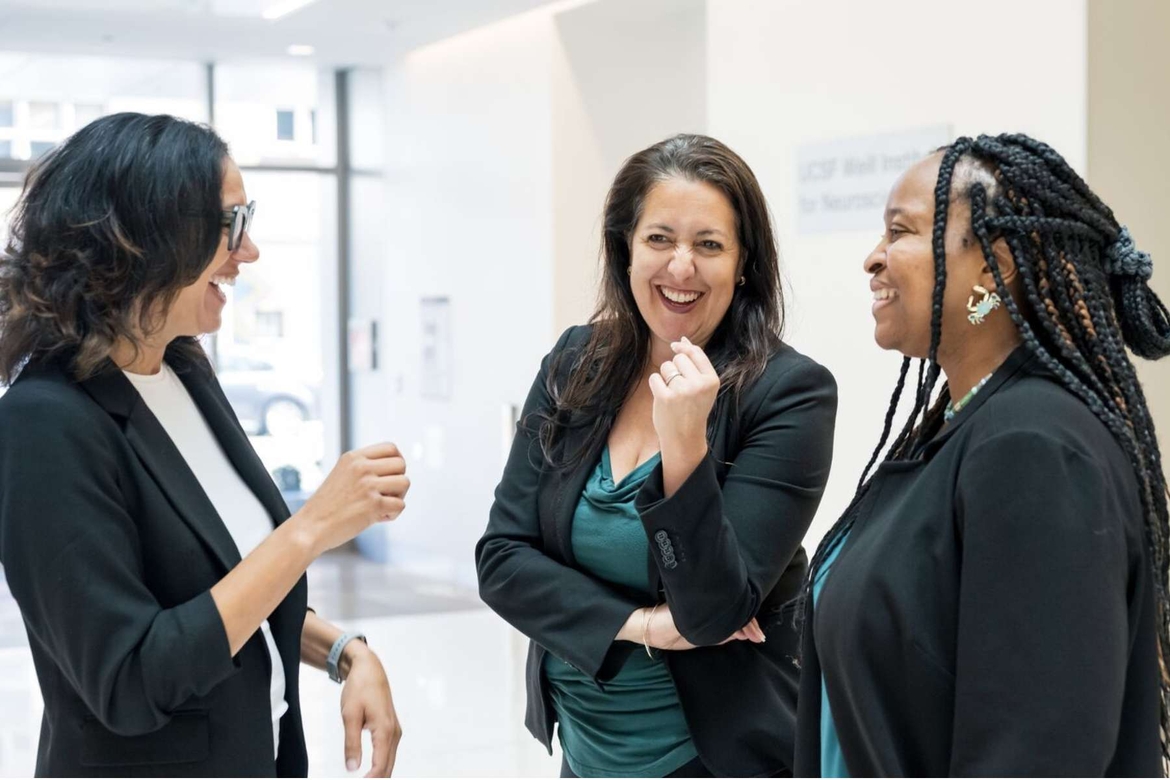
Ogbu-Nwobodo first joined UCSF two years ago as both a full-time faculty member and part of the Public Psychiatry Fellowship, which Mangurian herself co-founded. While she had “known about Christina for many years” before coming to UCSF, Ogbu-Nwobodo’s experience working up close and personal with her exceeded those expectations.
“She makes you feel like she has all the time in the world for you,” Ogbu-Nwobodo said. “It’s a really special gift that she has.”
When she completed the fellowship, Mangurian recruited Ogbu-Nwobodo to join the core faculty, where she’s now associate program director. Today, the two continue their work together, including publishing a new perspective in the New England Journal of Medicine about the impact of a recent U.S. Supreme Court ruling on the Constitution’s protections for abortion on marginalized groups with mental illness. They’re also working to expand mental health services for disadvantaged communities through partnerships with leadership in several Bay Area counties and a new partnership with the California Department of State Hospitals.
“It’s about your relationship with someone, and that you’re standing with them to help guide them to achieve their goals,” Mangurian said. “I’ve had a lot of different kinds of mentees. Some want to do research. Some want to be clinician leaders. Some want to be educators. It’s my job to help them find out what fills their cup and help them get there.”
Mangurian, a native of Maryland, first came to UCSF in 1997 shortly after graduating with a degree in biology from Reed College in Portland, Oregon. She started as a research assistant at the Institute for Health Policy Studies, hired by Lisa Bero, PhD – ironically the first person to ever receive the Harold S. Luft Award in 2009. In 1999, Mangurian started medical school at UCSF.
“I’m somebody that likes to keep my doors open,” she said of the choice to enroll at UCSF. “I felt like I could do a lot of different things as a physician, taking care of patients, doing research, teach, and even making a film if I wanted to.”
While she’s not yet made that film (her husband is actually a documentary filmmaker), she’s produced a career worthy of the big screen.
Image
Mangurian has grown into a national leader in health services research focusing on improving medical care for people with serious mental illness. As a Latina physician scientist, she has also mobilized first-hand experience to understand opportunity gaps in academic medicine for historically excluded faculty. In fact, she has become nationally recognized for her research and leadership in promoting equity among faculty in academic medicine.
“She’s someone who’s really good at developing and sustaining impactful programs,” Ogbu-Nwobodo said. “I’ve never met someone who’s as prolific as she is in thinking things through and creating ways to keep those things going. She starts them and she also sustains them for the long run.”
The UCSF Department of Psychiatry and Behavioral Sciences, together with the Langley Porter Psychiatric Institute, is home to some of the nation’s leading experts in mental health. We are deeply committed to advancing mental health for all by providing world-class patient care, conducting innovative and transformative research, training the next generation of mental health leaders, advancing health equity, and strengthening communities.
About the UCSF Weill Institute for Neurosciences
The UCSF Weill Institute for Neurosciences, established by the extraordinary generosity of Joan and Sanford I. "Sandy" Weill, brings together world-class researchers with top-ranked physicians to solve some of the most complex challenges in the human brain.
The UCSF Weill Institute leverages UCSF’s unrivaled bench-to-bedside excellence in the neurosciences. It unites three UCSF departments—Psychiatry and Behavioral Sciences, Neurology, and Neurological Surgery—that are highly esteemed for both patient care and research, as well as the Neuroscience Graduate Program, a cross-disciplinary alliance of nearly 100 UCSF faculty members from 15 basic-science departments, as well as the UCSF Institute for Neurodegenerative Diseases, a multidisciplinary research center focused on finding effective treatments for Alzheimer’s disease, frontotemporal dementia, Parkinson’s disease, and other neurodegenerative disorders.
About UCSF
The University of California, San Francisco (UCSF) is exclusively focused on the health sciences and is dedicated to promoting health worldwide through advanced biomedical research, graduate-level education in the life sciences and health professions, and excellence in patient care. UCSF Health, which serves as UCSF’s primary academic medical center, includes top-ranked specialty hospitals and other clinical programs, and has affiliations throughout the Bay Area.