
The call experience at UCSF provides the skills needed to manage patients overnight on the inpatient psychiatry units, provide consultation to medical-surgical services, as well as the skills needed to assess and manage behavioral emergencies.
When starting call, interns have a tandem experience with a senior resident before progressing to indirect supervision with an attending psychiatrist. The philosophy of call is to promote independence and autonomy while maintaining educational excellence and supervision.
Call for First-Year Residents
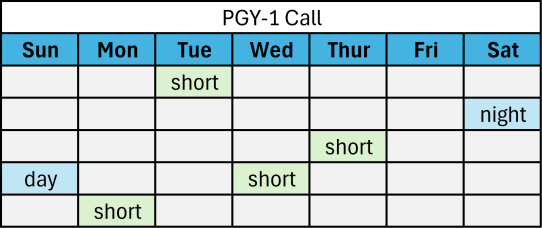
First-year residents (PGY-1s) take psychiatry call at Zuckerberg San Francisco General Hospital and Trauma Center (ZSFG) when on their psychiatry months. Call is largely a night float system.
Our program’s culture appreciates the complexities of people’s schedules and lives, and trades of short call shifts between interns are welcomed.
The different shifts are as follows:
- Short Call – Monday through Fridays, 5 to 8 p.m.
- Evenly distributed between the eight residents rotating on ZSFG inpatient psychiatry and Clinical and Emergency Experience (CEE); typically, residents are scheduled for approximately one short call (three hours) per week. The short call resident takes sign-out from co-residents and stays after the regular workday, until the night float resident arrives for their shift.
- Night Float – Six-night block, Sunday through Friday, 8 p.m. to 8 a.m.
- PGY-1s do three weeks of night float in total. About half the class does their three consecutive weeks while on their CEE rotation. The other half does two consecutive weeks during their CEE rotation and one week during their ZSFG inpatient psychiatry rotation.
- Weekend Call – Saturday or Sunday, 8 a.m. to 8 a.m. or 8 p.m. to 8 a.m.
- On weekends, a PGY-1 resident takes call for a Saturday 12-hour a.m. shift, a Saturday 12-hour p.m. shift, or a Sunday 12-hour a.m. shift until the night float resident arrives for their shift on Sunday evening. One of these shifts is taken approximately 1-2 times per month (while on psychiatry rotations).
During orientation (the first couple of weeks on the ZSFG psychiatry inpatient service), PGY-1s do not have night float and are always on call (short call or weekend shifts) together with an upper-level resident. Indirect supervision — with direct supervision available — then becomes the model once each PGY-1 meets the required competencies as assessed by their supervisors and reviewed by the site and program directors.
At all times, faculty provide supervision as “faculty backups” for residents while they are on call at ZSFG. These supervising physicians are available by pager during the night and during the daytime on weekends and holidays. They come into the hospital on weekends and holidays to see all new patients and provide direct supervision to on-call residents. In addition to the faculty backup being available to the PGY-1 at all times, an attending psychiatrist is in house 24/7 in the ZSFG Psychiatric Emergency Service and always available to provide immediate direct supervision.
While on medicine and neurology rotations, psychiatry PGY-1s take call following the same schedule as interns on those services. ACGME clinical and educational work hours (“duty hours”) regulations are followed across all services.
Call for Upper-Level Residents
Residents in the PGY-2 and PGY-3 years take call at the UCSF Medical Center at Mount Zion (covering the Langley Porter Psychiatric Hospital and UCSF Mount Zion psychiatry consultation service), assist PGY-1s on weekend call at ZSFG by rounding on psychiatric consultation patients, and the San Francisco VA Medical Center (SFVAMC), as described below. Faculty provide supervision as “faculty backup” for residents while they are on call at either Mount Zion or SFVAMC. PGY-4 residents do not take call, except for two weeks of non-consecutive weeks of night float at SFVAMC. The supervising attendings are available to residents on call by pager at all times.
Our program’s culture appreciates the complexities of people’s schedules and lives, and residents are encouraged to trade call shifts with one other, to optimize their schedules to suit their preferences. For example, a resident may choose to split up their 24-hr shifts into two 12-hour shifts if they prefer, or vice versa.
The following are brief descriptions of the current frequency of calls across the different residency years.
PGY-2 Call
- Three non-consecutive weeks of five-day night float (5 to 8 p.m.): Two weeks at SFVAMC and one week at the UCSF Langley Porter Psychiatric Hospital at Mount Zion.
- PGY-2s cover approximately 60% of all the weekend call shifts at SFVAMC, ZSFG, and Langley Porter, which includes: regular weekend call, three-day weekend call, Thanksgiving and Winter Holiday call, and occasional non-night float weeknight call.
- One tandem shift at Langley Porter with a PGY-3, prior to first independent call at that site, on a Saturday or Sunday from 8 a.m. to 5 p.m.
- On average, a PGY-2 will take approximately one weekend call (8 a.m. to 5 p.m.) per month, one overnight shift (5 p.m. to 8 a.m.) every two months, and three additional 24-hour weekend shifts spread across the year.
PGY-3 Call
- Two non-consecutive weeks of five-day night float (5 p.m. to 8 a.m.) at UCSF Langley Porter Psychiatric Hospital at Mount Zion.
- PGY-3s cover approximately 40% of the remaining weekend call at SFVAMC, ZSFG, and Langley Porter, which includes: regular weekend call, three-day weekend call, and occasional non-night float weeknight call.
- On average, a PGY-3 will take one weekend call (8 a.m. to 5 p.m.) every two months, one overnight shift (5 p.m. to 8 a.m.) every two months, and two additional 24-hour weekend shifts spread across the year.
PGY-4 Call
- PGY-4 residents do not take call, except for two non-consecutive weeks of five-day night float at SFVAMC.
- Chief residents take only one week of night float.
Jeopardy Back-Up System
Jeopardy is a back-up system for call shifts which designates one PGY-2 or PGY-3 resident per 24-hour period to stand by for coverage in case an originally assigned resident becomes unable to work their call shift.
While routine scheduling issues are resolved through swaps between residents, jeopardy may be activated when a resident is unable to perform work duties due to physical or mental conditions, for urgent unforeseen life circumstances, or emergency medical care. The system is designed to provide reassurance to any resident that they can safely request back-up when they become unable to work, knowing a colleague is ready and available to cover.
PGY-2 and PGY-3 residents are each assigned approximately 12-14 jeopardy days per year.
- Three non-consecutive weeks of five-day night float (5 to 8 p.m.): Two weeks at SFVAMC and one week at the UCSF Langley Porter Psychiatric Hospital at Mount Zion.
- PGY-2s cover approximately 60% of all the weekend call shifts at SFVAMC, ZSFG, and Langley Porter, which includes: regular weekend call, three-day weekend call, Thanksgiving and Winter Holiday call, and occasional non-night float weeknight call.
- One tandem shift at Langley Porter with a PGY-3, prior to first independent call at that site, on a Saturday or Sunday from 8 a.m. to 5 p.m.
- On average, a PGY-2 will take approximately one weekend call (8 a.m. to 5 p.m.) per month, one overnight shift (5 p.m. to 8 a.m.) every two months, and three additional 24-hour weekend shifts spread across the year.
- Two non-consecutive weeks of five-day night float (5 p.m. to 8 a.m.) at UCSF Langley Porter Psychiatric Hospital at Mount Zion.
- PGY-3s cover approximately 40% of the remaining weekend call at SFVAMC, ZSFG, and Langley Porter, which includes: regular weekend call, three-day weekend call, and occasional non-night float weeknight call.
- On average, a PGY-3 will take one weekend call (8 a.m. to 5 p.m.) every two months, one overnight shift (5 p.m. to 8 a.m.) every two months, and two additional 24-hour weekend shifts spread across the year.
- PGY-4 residents do not take call, except for two non-consecutive weeks of five-day night float at SFVAMC.
- Chief residents take only one week of night float.
Jeopardy is a back-up system for call shifts which designates one PGY-2 or PGY-3 resident per 24-hour period to stand by for coverage in case an originally assigned resident becomes unable to work their call shift.
While routine scheduling issues are resolved through swaps between residents, jeopardy may be activated when a resident is unable to perform work duties due to physical or mental conditions, for urgent unforeseen life circumstances, or emergency medical care. The system is designed to provide reassurance to any resident that they can safely request back-up when they become unable to work, knowing a colleague is ready and available to cover.
PGY-2 and PGY-3 residents are each assigned approximately 12-14 jeopardy days per year.